
Home vs Public EV Charging in Saudi Arabia: A Real-World Cost and Convenience Comparison
Should you charge your EV at home or use public chargers? We compare cost, speed, convenience, and battery impact, with advice specific to Saudi Arabia.

Every EV owner in Saudi Arabia faces the same early decision: buy a home charger, or rely on public charging stations? The answer affects your monthly running costs, your daily routine, and the long-term health of your battery. This guide compares home and public charging on speed, cost, convenience, and the real tradeoffs in Saudi conditions.
The short answer first. For more than 90% of EV owners in Saudi Arabia, home charging should be the main method, with public charging as a backup or for road trips. Home charging costs much less, is easier on the battery, and is far more convenient day to day. Public charging is there for longer trips and flexibility, not to replace home charging.
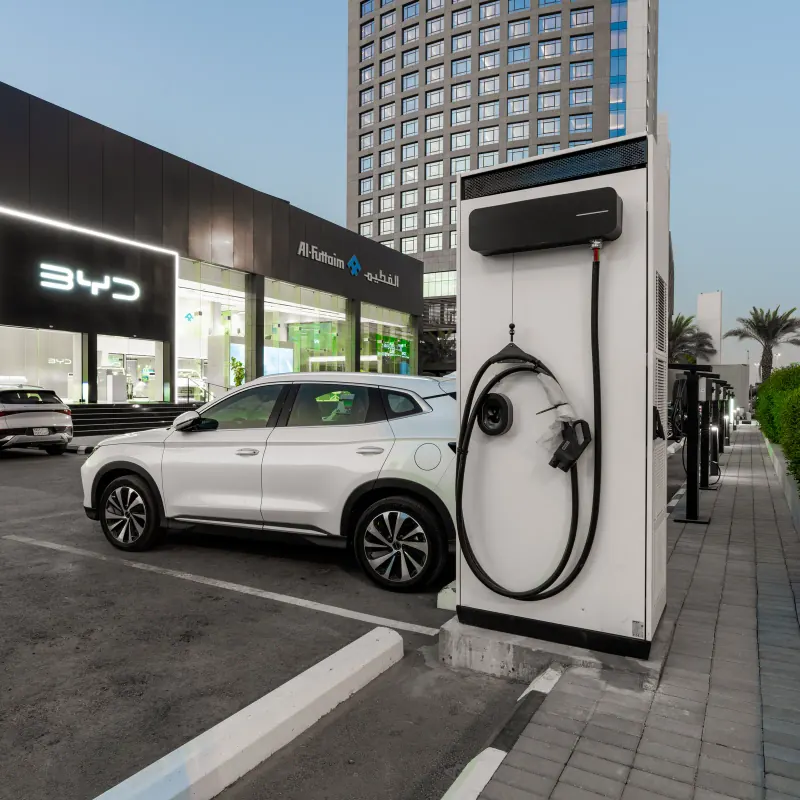
Speed comparison. Home Level 2 chargers (usually 7.4 kW or 11 kW) give a full charge in 6-10 hours, which fits an overnight cycle while you sleep. Public AC chargers offer similar speeds, but they are usually at malls or hotels where you wouldn't stay for 8 hours. Public DC fast chargers (50-150 kW or higher) can charge most EVs from 20% to 80% in 25-45 minutes. Ultra-fast 250+ kW chargers can do it in 15-25 minutes for compatible vehicles. So for road trips, when speed is what you need, public DC is the best option. For daily charging, home is more than enough. Your car charges while you sleep, with no waiting.
Cost comparison. Public DC fast charging in Saudi Arabia costs much more per kWh than residential electricity, because the Saudi Electricity Company's residential tariff is far below commercial fast-charging rates. Over a typical month of 1,500 km of driving, the difference between charging mostly at home and charging mostly at public DC chargers is large. Owners who charge at home usually save thousands of riyals a year compared with those who rely on fast chargers. Exact tariffs change over time and vary by usage tier and operator, but the pattern holds: home is always cheaper than public DC.
Battery health impact. This is where home charging clearly wins. Slow Level 2 charging at home produces less heat in the battery cells, so the cells are under less stress and degrade more slowly over the years. Frequent DC fast charging speeds up battery aging, especially in Saudi summer, because each fast charge produces a lot of heat that the cooling system has to handle. In hot climates, EVs that rely mainly on fast charging lose battery capacity noticeably faster than EVs that mostly charge slowly at home. If you want your battery to keep its range as long as possible, charge at home.
Convenience: a real comparison. With home charging, you wake up to a full battery every morning. There is no waiting, no app, no payment, and no detour. With public charging, you have to find a station, hope it's free and working, deal with payment apps, and wait while the car charges. In Riyadh the public network is growing fast, but charging stations are not yet as common as petrol stations. If you plan ahead, public charging works fine. If you forget, you may end up worrying about range, which doesn't happen when you charge at home.
When public charging is the right choice. Long road trips between cities, such as Riyadh to Jeddah, Riyadh to Dammam, or Riyadh to AlUla, need fast public charging. There is no realistic alternative. Renters and apartment residents without dedicated parking sometimes can't install a home charger and have to rely on public stations. If you drive less than 100 km a week, one public charge a week may be enough. Travelers passing through cities can use public chargers for top-ups. And if you plan to install a home charger but haven't yet, public charging fills the gap until then.
Saudi-specific considerations. Public charging in Saudi Arabia is concentrated along major highways, in shopping malls, and at some hotels. Coverage is excellent on the main routes (Riyadh-Dammam, Riyadh-Jeddah) and getting better on secondary routes. Some stations are AC only (slow) and others are DC fast, so check before you go. Apps like the EVIQ app show station availability in real time. The network is generally reliable but not perfect, so have a backup plan whenever you depend on a single station.
How to decide what's right for you. If you have a parking spot at home with electrical access nearby, install a home charger. The convenience and savings make it an easy decision. If you live in an apartment without parking, talk to your building management. Many newer Riyadh developments are adding shared EV charging. If you drive less than 100 km a week, a weekly public charge might be enough. For most Saudi EV owners with a typical daily commute of 50-100 km, home charging should be the main method.
FAQ:
Do I really need a home charger if my EV came with a portable cable? Portable cables work, but they are slow. They are meant as a backup, not as your main daily charger. A dedicated wall charger is much faster and safer for daily use.
Will my battery degrade if I only use public fast chargers? Yes, faster than with home charging. Occasional fast charging is fine, but daily fast charging in Saudi heat noticeably shortens battery life over the years.
Can I install a home charger in a rental property? Sometimes. It depends on the property and your landlord. Some rental contracts allow it with the landlord's written permission. In some cases the charger can be removed and moved when you leave.
What if my home electrical panel can't handle a charger? You have options: a load-management charger that lowers its power automatically based on household demand, an SEC service upgrade, or a smaller 3.7 kW charger. A site survey by a qualified installer will tell you what your home can support.
Ready to plan a home charger or have questions about charging strategy? Contact EVS via WhatsApp, phone, or our online form, and we can arrange a Climatech site-survey request across Riyadh and the Central Region.
Tap into EVS expertise
Book a free check now — a certified technician will answer every question.

Related articles
Home EV Charger Cost in Saudi Arabia 2026: 7kW vs 11kW vs 22kW Prices
Home EV charger prices in Saudi Arabia (2026): 7kW vs 11kW vs 22kW units, installation fees, brands that handle 40°C summers, and the right size for your EV.
EV Charging Guide for Long Road Trips in Saudi Arabia
Taking an EV road trip from Riyadh to Jeddah, Dammam, or AlUla? A practical guide to charging stations and route planning.
Home EV Charger Installation in Saudi Arabia: A Practical Guide
Thinking about a home EV charger? This guide covers charger types, what to check before installation, and what the process looks like.